For years, digital marketers relied on third-party cookies and cross-site tracking to understand their audiences, retarget visitors and measure campaign performance. That era is coming to an end. Between tightening privacy regulations, the gradual phase-out of third-party tracking technologies, and growing consumer awareness around data usage, businesses can no longer build their marketing strategy on borrowed data.
In 2026, first-party data — information collected directly from your own customers through your website, email list, CRM and other owned channels — has become the true foundation of effective marketing. For UK businesses in particular, where GDPR compliance is non-negotiable and consumer trust is increasingly tied to brand reputation, building a first-party data strategy isn’t just a compliance exercise. It’s a genuine competitive advantage.
What Is First-Party Data, Exactly?
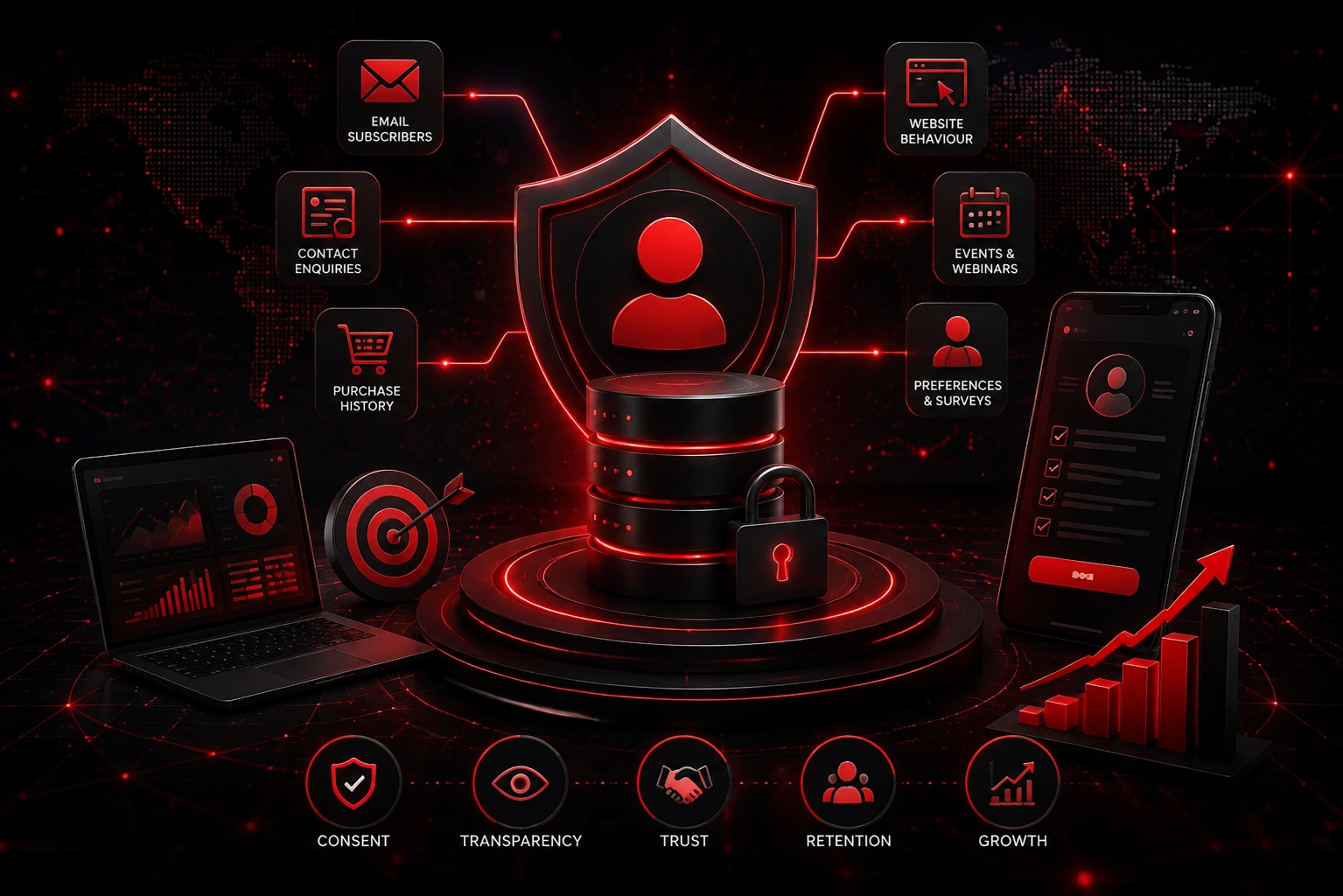
First-party data is any information a business collects directly from its own audience, with their knowledge and consent. This includes:
- Email subscribers and newsletter sign-ups
- Contact form enquiries and quote requests
- CRM records and purchase history
- Website behaviour tracked with proper consent
- Event registrations and webinar attendees
- Stated preferences gathered through surveys or account settings
Because this data comes directly from people actively interacting with your business, it tends to be more accurate, more relevant, and inherently more compliant with privacy regulations than data purchased or scraped from third-party sources.
A related concept, zero-party data, refers to information customers proactively share with a business — through preference centres, quizzes, or account setup — rather than data inferred from behaviour. This creates an even higher level of trust, since the customer is knowingly participating in the exchange rather than being passively monitored.
Why First-Party Data Has Become Essential in 2026
Third-party tracking is fading fast. Browser-level restrictions, ad-blocking technology and platform-level privacy changes have made third-party cookies increasingly unreliable. Marketers who built their entire measurement and targeting strategy around them are now facing real gaps in visibility.
Privacy regulation continues to tighten. GDPR remains central to how UK and EU businesses handle customer data, and enforcement has only become more rigorous. Businesses that treat privacy as an afterthought expose themselves to real regulatory and reputational risk.
Consumer trust is now a competitive differentiator. Modern customers are more aware than ever of how their data is used. Brands that are transparent about data collection — and that visibly respect the boundaries customers set — build stronger, longer-lasting relationships than those relying on invasive tracking.
Measurement itself is shifting. With legacy tracking broken by privacy changes, marketers in 2026 increasingly rely on a blend of methods: marketing mix modelling, incrementality testing, and platform-native dashboards, rather than a single source of granular, cross-site tracking data.
Building a First-Party Data Strategy: Where to Start
1. Give people a genuine reason to share their data
First-party data collection only works when there’s real value on both sides of the exchange. Gated guides, useful calculators, exclusive discounts, early access to new products, or genuinely helpful newsletters all give customers a clear reason to hand over their information voluntarily.
2. Centralise your data in one place
Scattered spreadsheets and disconnected tools make it nearly impossible to build a coherent view of your customers. A proper CRM — even a lightweight one for smaller businesses — allows you to consolidate email activity, website behaviour, purchase history and enquiries into a single customer profile.
3. Be transparent about what you collect and why
Clear, honest privacy messaging isn’t just a legal requirement under GDPR — it’s increasingly a trust signal that customers actively notice. Avoid burying consent requests in dense legal text; explain plainly what data you collect, how it’s used, and how customers can opt out.
4. Use progressive profiling instead of asking for everything at once
Rather than overwhelming a new subscriber with a long form, collect information gradually over time as the relationship develops — a name and email at sign-up, then preferences or interests through later interactions. This reduces friction while steadily building a richer customer profile.
5. Shift your measurement approach
Move away from relying solely on granular, cross-site tracking data. Combine platform dashboards (Google, Meta) for day-to-day optimisation with broader methods like marketing mix modelling or incrementality testing to validate what’s actually driving revenue, rather than just clicks or impressions.
6. Focus on retention, not just acquisition
First-party data isn’t only useful for acquiring new customers — it’s arguably even more powerful for retaining existing ones. Purchase history and engagement data allow for genuinely relevant follow-up communication, rather than generic broadcast messaging.
The Trust Dividend: Why Privacy-First Marketing Pays Off
There’s a common misconception that privacy-first marketing means sacrificing performance. In practice, the opposite is increasingly true. Businesses that build transparent, consent-driven data practices tend to see stronger engagement, because the audience they’re marketing to has opted in rather than being passively tracked. This alignment between customer expectation and business practice tends to produce more qualified leads and better long-term retention, even if top-line audience size is smaller than a broadly targeted, third-party-driven campaign.
There’s also a growing SEO dimension to this shift. Strong privacy practices and transparent data handling increasingly factor into how search engines and AI systems assess a brand’s overall trustworthiness — reinforcing signals like E-E-A-T (Experience, Expertise, Authoritativeness, Trustworthiness) that influence organic visibility.
Common Mistakes to Avoid
Treating data collection as purely a compliance checkbox. GDPR compliance is the baseline, not the strategy. Businesses that only think in terms of “what are we legally allowed to do” miss the bigger opportunity to build genuine, trust-based customer relationships.
Collecting data without a clear plan to use it. Gathering emails or enquiries without a defined nurture or segmentation strategy behind them leads to a growing, unused database rather than a genuine marketing asset.
Ignoring the human element. AI and automation can support research, personalisation and efficiency, but businesses that rely entirely on automated content and messaging often struggle to build the kind of trust that first-party relationships depend on. Strategy, creativity and customer relationships still need to be driven by people.
Conclusion
The shift toward first-party data isn’t a temporary adjustment to privacy regulation — it’s a fundamental redefinition of how effective marketing works. Businesses that continue to lean on third-party tracking and broad, undifferentiated advertising will find their visibility and effectiveness steadily eroding. Those that invest now in building genuine, consent-driven relationships with their audience — through useful content, transparent practices, and a properly centralised view of their customers — will be building a marketing asset that only grows more valuable over time.
For UK businesses navigating this shift, the opportunity is clear: privacy-first marketing isn’t a constraint to work around. It’s a foundation to build on.
Want to know how first-party-ready your current marketing setup really is? Our team can review your data collection, CRM structure and consent practices, and identify practical next steps to build a stronger, more compliant growth strategy.